State of Being
This is the 1st of 7 Articles in the Series “A Process of Change”
State of Being – What is our Current experience of Life (Intro)
Our State of Being is the state in which we are “being” at in any given moment. Our “beingness” is our State of experience of the current moment. We could say our State of Being is whatever we are experiencing as our life or reality in any given moment. It is our beingness, rather than our doingness. The way we measure the quality of life, our continuous feedback device.
You might currently be in the state of “joyfulness”, “happiness”, “bewilderment”, “sadness” or “anger” Meaning you are experiencing joy, anger, sadness, bewilderment or more simply put, you are happy. You might ask why am I spending time on these word games, I hope by the end of the article it will make sense.
How we Experience Life
We experience our State of Being through our physical sensations. We know we are sad, or happy, or full of joy, when we sense in our bodies what we’ve decided is joy, sadness or happiness. We learn through our own experiences and what others share about their experiences and sensations.
For many of us our State of Being, or simply “State” is constantly shifting from one state to another. It seems like we can experience many States at the same time, a blend of multiple emotions. We feel sad and confused, or Joy and anger. When asked how we are, we might simply reply with “I am good” or “I’m struggling”. Our State of Being is our “Am-ness”.

How Knowing your State of Being Helps You
You might be saying to yourself “ok that’s nice, but why do I care?”. The reason I am sharing this here is that most of us have never been taught about this core aspect of life. The current moment is the only place where we can experience anything, where we can change anything, and change is life.
Before we can change our experience, we must first be aware of our experience. From there we might go further with our awareness, to understand how that experience is being created, the roots of it. While we might not be aware of it, most of us are stuck repeating past experiences in new ways. We are constantly “re-acting” our past upsets again and again, by reacting instead of responding to what happens in our lives. We find ourselves in the same experiences, the same stress, the same heartache, the same struggle as we did in the past.
Wherever we go, there we are. Or wherever we go, there our memories are.
States of Being – The Experience

Experience Different States of Being
Or download an MP3 of the Experience
I believe that if an image is worth a 1,000 words, a personal experience is worth a 1,000,000 words.
Learn More about the Experiences offered here at Totality Counselling
The basis of all States of Being
Our States of Being are all based on varying degrees or levels of intensity of either safety or threat. When we boil it down to its core, we are in either a state of “good or bad”, “positive or negative”, “Love or fear”. We feel expansive or contracted, the yin and the yang of our lives, and the universe.
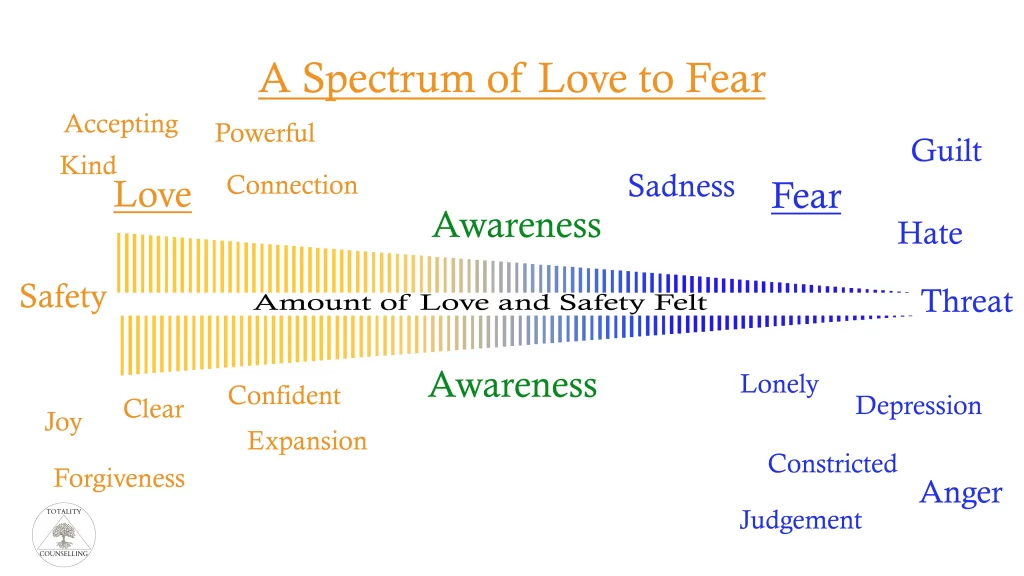
Our lives are made up of varying degrees of experience of these states. Generally, we look at these seemingly opposing State of Being as opposites of each other, two separate things. Another way to see these opposites, are varying levels or degrees of the same State. Bad is less good than good is, Fear is the absence or a smaller degree of Love, threat is a very small amount of safety. With this in mind you could see “Sad” as a smaller amount or degree of “Joy”. We often imagine that opposites are against or battling each other. An example of this thinking is light and darkness. When we shine a light in a dark space, we don’t remove the darkness. Darkness can’t exist in the presence of light; we turn up the amount of light.
I believe Love and safety is our natural state, the core of our being. I see fear as a disconnection or lesser experience of that Love. That doesn’t mean that fear doesn’t have its place of importance. If we didn’t know fear, could we really appreciate love? It’s the contrast of something that enables us to know what we desire. Without a lack of safety, what value would safety have? How would we be able to understand and appreciate our experiences, if we didn’t have something to compare it to?
I might have strayed a little off topic here but I find these concepts have really helped me to open up inside, to shift my perspectives of my experiences. When we are not opposed to something, it feels less confrontational, we can shift rather than completely turn around. Like a door that opens inward, we can’t get free until we take a step back. My hope is that these perspectives might offer you something valuable as well.
How we Express or Communicate our States of Being
In English we describe our States of Being in a variety of ways. All are a way of describing how “we” are, how our beingness is in the moment. We describe our state by describing how we are feeling. It might be something like “I am feeling angry”, or “I am feeling joyful”. We use verbs to describe our State of Being; expressions like “I am sad” or “I’ve been confused” or “She seems angry”.
We use the suffix “ness” with different nouns to relate our current experience of life, we say things like “I am filled with joyfulness”, or “Your bluntness is upsetting me”, or “It’s my hopefulness that keeps me going”. Or it might sound more like “I fear my sadness is going to overwhelm me” or “My nervousness keeps me from asking for that raise”.
Generalized Descriptions of Experience
When we feel or experience something we aren’t familiar with, we will group that experience in with something we have experienced, something we have a reference for. This is how our brain assists us in navigating our lives and communicating our experiences.
When we aren’t aware how something impacts us, how we feel about it, we will often say things like “Well that’s weird” or “they are really strange”. These ways of describing a thing or person are ways of summing up a sense of uncertainly of how we feel about it. Often, we generalize our experiences by describing them as “good” or “bad”. If something is good, we have a safe or positive relationship to it. If we describe it as “bad”, then have a negative view of it, for some reason.
An Everyday Example – How was your Day?
An example of this is when I ask my son “how was your day at school”? Most days I get something along the lines of “It was good” or “It was bad because… ”. I am learning to ask different questions to help him answer more fully or descriptively. Questions like “Who did you play with at school?” or “Who did you help?” or “Did something feel hard today?” tend to get more information about what he experienced at school, as well as what he makes those experiences mean for him. These questions are helping him to think about his day differently and find new ways to describe his experience. This benefits him as he reflects on his experience, reflection is using our awareness to gain greater understanding of our experience. It can be challenging for me to change the way I communicate with him, I spent much of my life not asking these types of questions of anyone, he is my teacher, or should I say my experiences with him are my teacher.

Getting to Know our “States of Being”
How do we know what we are experiencing in any given moment? Our moment-to-moment experience or our State of Being is reflected to us by the sensations in our bodies, the feelings and emotions we experience. Our State of Being is also reflected in what we are thinking, believing and perceiving in the moment.
Many of us are disconnected from what is happening in our bodies, and how we actually feel. For most of us understanding ourselves emotionally wasn’t part of our education. We weren’t taught how to reflect on our beliefs and thoughts, where those thoughts and beliefs came from, and how they are impacting our current life experience.
An Example of a State of Being – Anger
When we describe ourselves as “angry”, we are saying our current State of Being is one of anger. In our bodies we might feel constricted, confined or tense. We might feel hot or tingling sensations, often in the gut, chest and throat. If we check in with ourselves, or reflect on what is happening for us in the moment, we might notice there are thoughts of wanting to punish, get revenge or attack someone.
Anger is often a reaction to feeling trapped, needing to protect ourselves, or stand up to an injustice. This is a normal survival reaction based in fear. We feel anger when we don’t feel safe. The State of Being “angry” is very often experienced alongside with thoughts like “why did they do that?”, “they are wrong” or “why are they such jerks?”. We have been taught to look at the external thing associated with the experience of feeling upset, rather than to look at our internal experience of it, and where it is rooted.
In other situations, like when we are physically in danger, being angry can be helpful and appropriate, it fills our bodies with what we need to take action.
Our Brains and Nervous Systems Organize our Feelings with the Thoughts that Go with Them
Our bodily experiences or emotions are how we detect or define our State of Being. When we feel something, it’s most often linked to a past experience that seems related to it. We feel how we felt in the past, when we had similar experiences to what is currently happening. Our brain organizes these feelings with the thoughts associated with them through our neural pathways in our brains. Our memories, both thoughts and emotions, of past events and experiences are grouped together in our brains, as protective defensive mechanisms, based on past, fear inducing experiences. Alternatively, we group safe, protective and supportive memories, with warm feelings and encouraging thoughts through other pathways in the brain.
Life – A mixing of States of Being
Our State of Being is changing constantly. We might experience frustration with our partner or child, while in the next moment we have understanding and compassion for them. Frustration is like a low-grade anger and is based in fear, while understanding is a form of love and safety. We experience varying degrees of experience, we shift from upset to peace, faster than we can think, we are constantly doing this, often without even knowing it’s happening.
A positive example of this is when we do something even when we are afraid to do it. Public speaking is a great example, we feel fear as nervousness, while in the next moment we feel courageous and confident that we can do it. We feel the fear, and do it anyway.
States of Being – In Therapy
As a therapist I am constantly tracking and guiding my clients through their State of Being moment to moment. Often, I guide them to use the States of Being rooted in Love to care for the fearful states they encounter. I assist my clients in becoming more aware of the states of love and safety they are experiencing within themselves, and through their experiences with others. As they bring awareness to them, they can choose to expand these States of Being, to intentionally choose loving states instead of the feelings of fear. They learn to care for their experiences of anger or sadness, with the aspects of themselves that are accepting, compassionate and willing. We all have these loving aspects inside of us, that can balance and hold the fearful aspects, but most haven’t been taught how to do it consciously.
Often this starts through the loving and accepting aspects of another person. We first experience love and acceptance as a shared experience with another, they share and model it for us. When clients are not able to love and hold themselves, I use the loving aspects I have cultivated to create safety for their fearful parts, until they are ready to do it themselves. This is a simplistic way to see Secure Attachment, we use the stable rooted aspects of us to love and take care of another’s fearful parts, until they learn to do it for themselves.
Changing our States of Being through the State of Awareness
Something you might not be aware of is, you are able to change your State of Being through the State of Awareness. We can decide or choose how to feel to varying degrees. As I shared above, our State of Being is influence or guided by our past experiences. This influence works through our memory of past experiences, the memories of how we felt, combined with the thinking and beliefs we associate with those experiences. As a survival instinct our brains and nervous systems often prioritize the memories of fear, to maintain our physical safety.
Over time we can rewire our brains and nervous systems away from these fearful memories, to more expansive life serving ones. This involves an inner decision; we must choose to be Willing to become aware of what we are experiencing in the present. We become aware of our emotions by experiencing our emotions, awareness of emotions is feeling our emotions.
I have found when we start from States of Being like awareness, Willingness and Personal Responsibility we are supported by these States of Being. When we intentionally feel our emotions, we are supported and held by our Core Self, the part of us that greater than what we feel. This enables us to feel our emotions without being overwhelmed by them. IFS or Internal Family Systems calls this “accessing self-energy”. Often my clients aren’t able to do this for themselves right away, through the trusting relationship we build together, they are able to use my support to feel their emotions and change their experiences with them. They borrow my self-energy so to speak, yet another way to describe Secure attachment.
The State of Awareness Changes Everything
Only from a State of Awareness do we take back our power, our choice to decide what our next experience is going to be. That doesn’t mean we necessarily change what happens to us on the outside, but we change how we feel and think about it. Awareness empowers us to step back from what we are experiencing, and decide what meaning we will take from it. When we change the meaning, what we make of things and events, we change our relationship to them. Once we change how we feel and think, our outer experiences shift, to reflect those changes.
Awareness – How we change our States of Being long Term
Awareness is a State of Being that is open and receptive to understanding our other States of Being. Awareness is like a pivot point, where we can step back from the other experiences we are having, and learn about them. It’s how we shift from reacting from our subconscious memories to responding from a place of choice.
We can’t change something we aren’t aware of. We can’t change what we don’t know about. Only when we come to know our bodily sensations, can we make peace with them. Only as we become aware of our beliefs and values, how they were created, are we empowered to decide to keep them, or to change them to something that serves us in a better way.
Awareness creates space around a thing, so that we might inspect it from a distance, then decide what it means to us in this current moment, and what it will mean to us going forward. Creating space within us, and space around aspects of ourselves, allows us to see things more holistically or more as a whole.
Using Awareness to Hold our Experiences of Fear with Love
From the State of Awareness, we are able to view things from a less reactive point of view, or perspective, it allows us to gain knowledge and understanding of what drives us into fearful States and knee jerk reactions. It gives us the choice to feel love, for the part of us that is angry. The state of awareness allows us to consciously mix safety in with our fear, so that it can be addressed at its root, so that we may integrate it, into us. Safety provides the opportunity to learn what our fear can teach us, then let it go, if that is best for us. Once we are integrated, we are no longer at the mercy of our fear.
Knowing something Provides an Opportunity of Freedom
What I found with my clients and for myself, is that as more and more of the unknown, becomes known, it poses less of a threat to us. As we learn and build trust with ourselves, in our abilities to feel our emotions without becoming overwhelmed, the uncertainty of our emotions shifts to more certainty. We become certain of things; we are aware of. When we shine a light on something, the fear of the unknown can no longer exist.

The State of Awareness is key in making the unknown known, key to shining a light on uncertainty. What I’ve found, is that as our awareness grows, we build internal trust with ourselves, the more this trust builds, the more we know we can handle even what we aren’t aware of yet. This growth of Self, is real freedom.
As we become more certain of ourselves, we trust our “self” enough to handle whatever life throws at us. This builds and builds until there, is almost nothing we can’t overcome. The goal posts in life will forever be moving, we will never be able know everything, guaranteeing our safety, so we must carry safety with us, wherever we go.
As they say “knowledge is power”, I would say knowing ourselves is power, it empowers us to choose our inner response, our experience of life.
Knowing our Experience Changes Everything
As a therapist one of the main things, I do with my clients is to help them become aware of their experiences, aware of what within them is creating those experiences, and how they can choose to have a different experience.
Ultimately understanding our States of Being through awareness is key to improving our lives, it brings back our ability to choose. We take back the power to determine how outer events, will impact us internally, how they will impact our States of Being, which is our experience of life. I can’t imagine anything more important to us than how we experience life.